



The bathroom is where most home falls happen — and the toilet is one of the most vulnerable moments of any day. That split second of lowering down or pushing back up to stand is when balance is most challenged, whether you're recovering from a knee replacement, managing arthritis, or simply finding that your legs don't cooperate the way they once did.
Two of the most recommended solutions are toilet safety frames and toilet safety rails. They look similar at a glance, but they serve different needs, fit different bathrooms, and suit different lifestyles. Choosing the wrong one doesn't just waste money — it can mean an aid that sits unused because it doesn't feel right in daily life.
This guide breaks down exactly how these two bathroom aids compare, who each one is designed for, and what physical therapists typically consider when making recommendations. By the end, you'll know which option fits your situation — and feel confident making the choice on your own terms.
Why Toilet Support Matters More Than You Think
It's easy to overlook the toilet as a safety concern — until it becomes one. According to the CDC, adults 65 and older experience falls at a rate that makes them a leading cause of injury at home, and the bathroom ranks among the highest-risk rooms in any house. The act of sitting down and standing up from a toilet requires significant lower-body strength, core stability, and balance — all things that naturally shift with age, surgery, or chronic conditions like arthritis or Parkinson's.
For caregivers, there's an added layer of concern: assisting someone in the bathroom is physically demanding and can compromise the dignity of the person being helped. The right support aid changes that equation completely. It lets the person using it do things independently, without needing to call for help each time. That's not a small thing — independence in the bathroom is closely tied to overall confidence and quality of life at home.
Both toilet safety frames and toilet safety rails address this need, but in meaningfully different ways. Understanding those differences is the first step toward making the right choice.
What Is a Toilet Safety Frame?
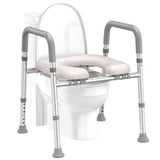
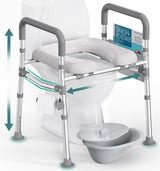
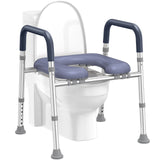
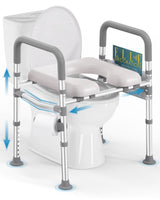
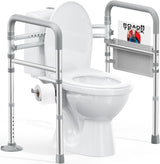
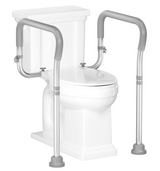
A toilet safety frame is a freestanding or toilet-mounted structure that surrounds the toilet on both sides with padded armrests. Think of it as a portable support station that you position directly over or around your existing toilet. Most frames feature two upright armrests connected by a rear stabilizing bar, and the user grips both sides simultaneously to lower themselves down and push back up.
Because the support is bilateral — meaning both arms do the work together — toilet safety frames distribute effort evenly. This is particularly helpful for people with weakness on both sides of the body, those in post-surgical recovery, or anyone who needs a very stable, structured push-off point. Many models are also height-adjustable, which means the armrests can be raised or lowered to match the user's proportions and the height of the toilet.
Freestanding frames are especially popular because they don't require any permanent installation. They sit on the floor around the toilet, held in place by their own weight and the user's downward pressure. Some models are designed to bolt onto the toilet itself for added security, but the no-tool, no-drill versions remain the most practical for most households — especially renters or people who move between homes.
HOMLAND's toilet safety rail collection includes options engineered for tool-free setup, adjustable height ranges, and heavy-duty load capacities — so the frame works for a wide range of users right out of the box.
What Are Toilet Safety Rails?
Toilet safety rails — sometimes called grab bars or side-mount rails — attach directly to the toilet itself, typically using the existing toilet seat bolts or a clamp mechanism that fits around the bowl. Unlike frames, rails are fixed to the toilet rather than freestanding on the floor, which gives them a lower profile and a more built-in appearance.
Most rails provide a single handle or a pair of compact handles on either side of the seat. They're designed for users who need a point to grip and steady themselves during the sit-to-stand transition, rather than full bilateral arm support. This makes them well-suited to people with one-sided weakness, mild balance concerns, or those who simply want a discreet assist without a large frame taking up bathroom space.
Because they mount to the toilet, rails tend to have a smaller footprint. They work well in tighter bathrooms where a full frame would feel cramped or interfere with movement around the toilet. The trade-off is that they generally offer less overall support than a safety frame — so they're best for users who are largely independent but want a reliable grip point rather than full structural assistance.
Key Differences at a Glance
Before diving into who each product suits best, here's a side-by-side summary of the core distinctions between toilet safety frames and toilet safety rails:
- Support type: Frames offer full bilateral armrest support; rails provide a grip point on one or both sides.
- Stability level: Frames are generally more stable for users with significant weakness; rails are lighter-duty but sufficient for mild support needs.
- Footprint: Frames take up more floor space; rails are compact and toilet-mounted.
- Installation: Most frames are freestanding with no tools needed; rails attach directly to the toilet and may require minimal setup.
- Portability: Freestanding frames are easy to move between bathrooms; mounted rails stay with the toilet.
- Ideal user: Frames suit post-surgery recovery, bilateral weakness, and heavier users; rails suit mild balance issues, one-sided weakness, and smaller bathrooms.
Neither option is universally better — the right one depends entirely on the user's physical needs, bathroom layout, and lifestyle.
Who Should Choose a Toilet Safety Frame?
A toilet safety frame tends to be the stronger choice in situations where the user needs consistent, full-body support to complete the sit-to-stand movement safely. If you or a loved one falls into any of the following scenarios, a frame is likely the better fit.
Post-surgery recovery is one of the most common use cases. After a hip or knee replacement, the muscles around the joint are temporarily weakened, and the range of motion is restricted. Pushing up from a toilet using both armrests — rather than relying on just a grip rail — reduces the load on the recovering joint significantly. Physical therapists frequently recommend bilateral support during this window.
Significant bilateral weakness is another clear indicator. If both legs feel unreliable, or if conditions like Parkinson's disease or advanced arthritis make strength unpredictable, having armrests on both sides means the user can offload weight symmetrically and avoid compensating in ways that increase fall risk.
Heavier users also tend to benefit more from a frame. Full-frame designs typically carry higher weight capacities — some HOMLAND models are built to support up to 500 lbs — because the load is distributed across a larger, floor-anchored structure rather than concentrated at two bolt points on a toilet seat.
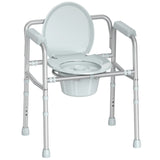
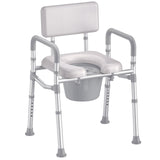
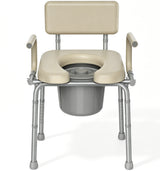
Finally, frames work especially well for people who use a bedside commode in addition to a standard toilet. Many safety frame designs are compatible with commodes or can be adapted across different settings, making them versatile for multi-room use. Browse HOMLAND's full bathroom safety product range to see how frames integrate with other aids.
Who Should Choose Toilet Safety Rails?
Toilet safety rails are a smart, space-conscious choice for users who are largely mobile and independent but want a reliable assist at the toilet. If the primary concern is confidence rather than structural support, rails often feel less intrusive and more natural to use.
One-sided weakness — common after a stroke or with conditions affecting one limb — is perhaps the most specific indicator for rails. A single well-placed grab rail on the stronger side lets the user push off with their good arm while the weaker side follows, preserving a natural movement pattern. Physical therapists who work with stroke survivors often begin with a rail on the stronger side before progressing toward no assist at all.
Smaller bathrooms are another practical consideration. A full safety frame extends outward from both sides of the toilet and requires clearance on the floor around it. In a compact bathroom where space is already tight, a frame can actually create new hazards by narrowing pathways or making the toilet harder to approach. Rails mount directly to the toilet, keeping the floor clear.
Users who are nearly independent but want peace of mind during nighttime bathroom trips are also well-suited to rails. Getting up at 2 a.m. in the dark, still half-asleep, is when even confident individuals can feel unsteady. A pair of rails gives a reassuring grip without making the bathroom feel clinical or equipment-heavy. It's the kind of quiet, dignified support that blends into everyday life.
What Physical Therapists Often Recommend
Physical therapists typically assess toilet safety needs based on a combination of factors: the user's strength, balance, weight-bearing restrictions (especially after surgery), bathroom layout, and how much assistance they currently need from another person. Rather than recommending one category universally, DPTs tend to match the level of support to where the user actually is in their recovery or daily function.
A common principle in physical therapy is to provide the least restrictive support that keeps someone safe. This means if rails are enough to allow someone to move independently and safely, a frame would be over-engineering the solution. Conversely, using rails when a frame is genuinely needed can leave someone relying on an aid that doesn't give them the stability they require — which is riskier than using no aid at all, because it creates false confidence.
HOMLAND's toilet safety products are authorized by licensed Doctors of Physical Therapy, which means the designs reflect real clinical thinking about how people move, where they need support, and what makes an aid actually usable in a home environment rather than just technically compliant. That distinction matters — a product that a DPT has evaluated is one designed to work the way the human body works, not just to check a safety box.
Installation and Setup: Easier Than You Expect
One of the biggest concerns caregivers express when buying bathroom safety equipment is the setup process. Nobody wants to spend a Saturday afternoon with a hardware manual, and most renters can't drill into walls or floors. The good news is that modern toilet safety frames and rails are designed with exactly this concern in mind.
Most freestanding toilet safety frames require no tools at all — they adjust via push-button height mechanisms and simply sit on the floor around the toilet. Setup typically takes less than five minutes, and the frame can be moved to a different bathroom just as quickly. This portability is particularly useful for families where the same aid might be needed in a guest bathroom or at a relative's home.
Toilet rails that bolt to the existing seat hardware do require a small amount of assembly, but most modern designs use hand-tightened bolts rather than specialized tools. HOMLAND's designs specifically prioritize tool-free or minimal-tool assembly across the product line, because an aid that's complicated to set up is an aid that gets left in the box.
Both types of aids are also FSA/HSA eligible, which means you can use pre-tax flexible spending or health savings account funds to purchase them — an important consideration that reduces the out-of-pocket cost for many families. HOMLAND ships from a US local warehouse for fast delivery, and every product comes with a 1-year manufacturer warranty plus a 1-year extended warranty, so the purchase is protected well beyond the initial setup.
Choosing the Right Fit for Your Home
If you're still weighing the two options, a few practical questions can help clarify the decision. Consider the current level of strength and balance: is the user mostly independent with occasional unsteadiness, or do they need reliable support to complete the movement every single time? Consider the bathroom layout: is there enough floor space for a frame, or would a wall-mounted or toilet-mounted rail be a better fit? And consider the likely duration of need: is this for a temporary recovery phase, or a long-term daily aid?
For temporary recovery (think 6-8 weeks post-surgery), a freestanding frame is often the most practical choice — it provides maximum support during the most vulnerable phase and can be easily returned to storage or passed along when it's no longer needed. For long-term daily use where the need is more about added confidence than structural support, rails are less visually dominant and feel more like a natural part of the bathroom.
And remember: these products aren't mutually exclusive. Some households have a frame in the primary bathroom and rails in a guest bath. Others start with a frame and transition to rails as strength and confidence return. The goal is always the same — moving through daily life safely, on your own terms, without the bathroom being a source of anxiety.
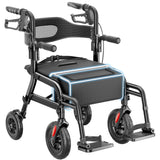
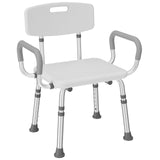
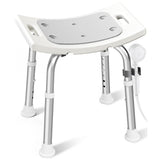
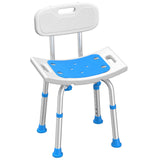
Explore HOMLAND's full toilet safety rail collection to find the right fit for your needs, or browse the complete HOMLAND product lineup for complementary aids like shower chairs, bed rails, and rolling walkers that support independence throughout the home.
The Bottom Line
Toilet safety frames and toilet safety rails both serve the same fundamental goal: helping you or someone you care about stay safe, confident, and independent in one of the most private moments of daily life. The difference lies in how much support is needed, how much space is available, and how long the aid will be in use.
Frames offer more structured, bilateral support — ideal for post-surgery recovery, significant weakness, or heavier users. Rails offer a lighter, more discreet grip point — ideal for mild balance concerns, one-sided weakness, or smaller bathrooms where a full frame would be impractical. Neither is a one-size-fits-all answer, and that's exactly why it's worth taking the time to match the aid to the actual situation rather than grabbing the first option that appears.
Whatever you choose, look for a product that's height-adjustable, built to a weight capacity that offers real confidence, and easy enough to set up that it actually gets used. Those aren't luxury features — they're what make the difference between an aid that sits in a closet and one that genuinely changes daily life at home.
Ready to Find the Right Fit?
Still have questions about which bathroom safety aid is right for your situation? HOMLAND's team is here to help you choose with confidence — no pressure, just honest guidance built on 20+ years of experience designing home mobility aids authorized by licensed physical therapists.
Browse the full toilet safety rail collection or contact HOMLAND directly and a member of the team will help you find exactly what you need. All products are FSA/HSA eligible, ship fast from a US local warehouse, and are backed by a 1-year manufacturer warranty plus a 1-year extended warranty — so you can shop with complete peace of mind.
Contact Us Today