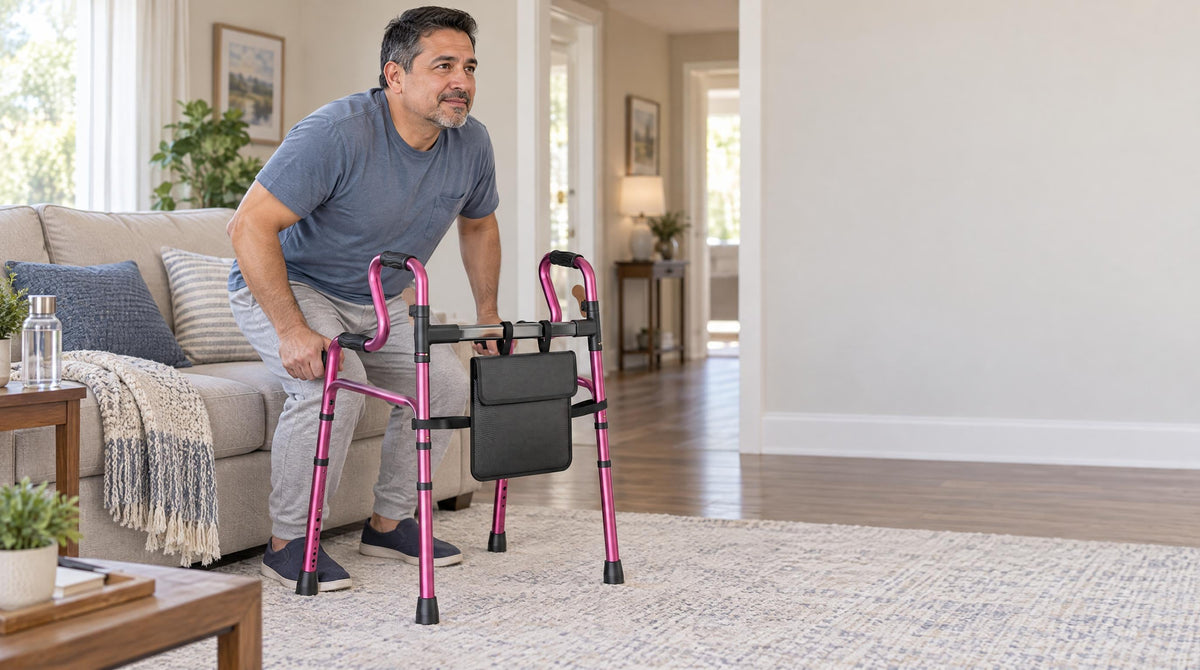
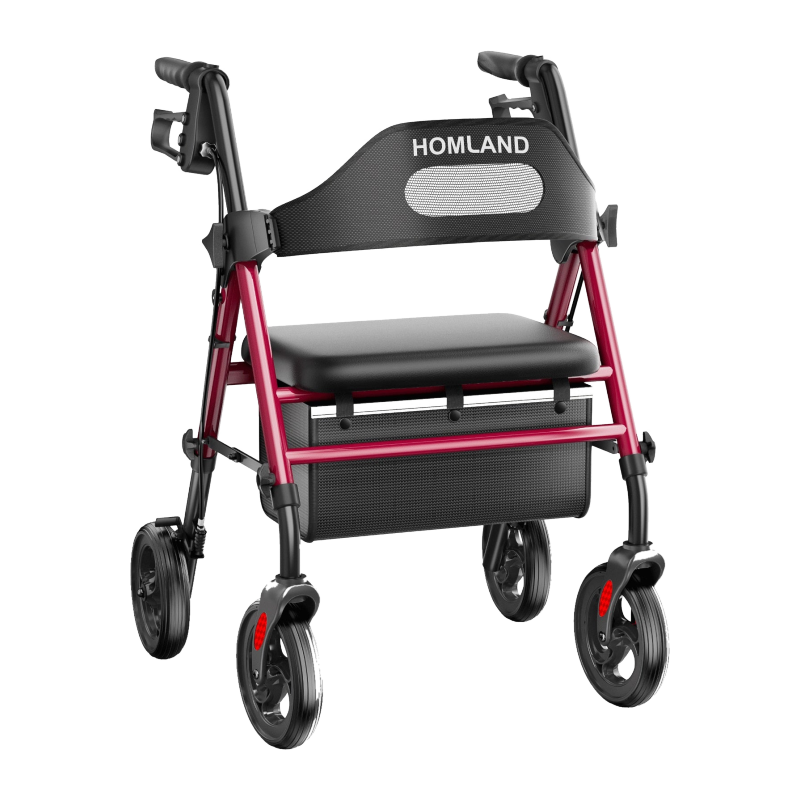
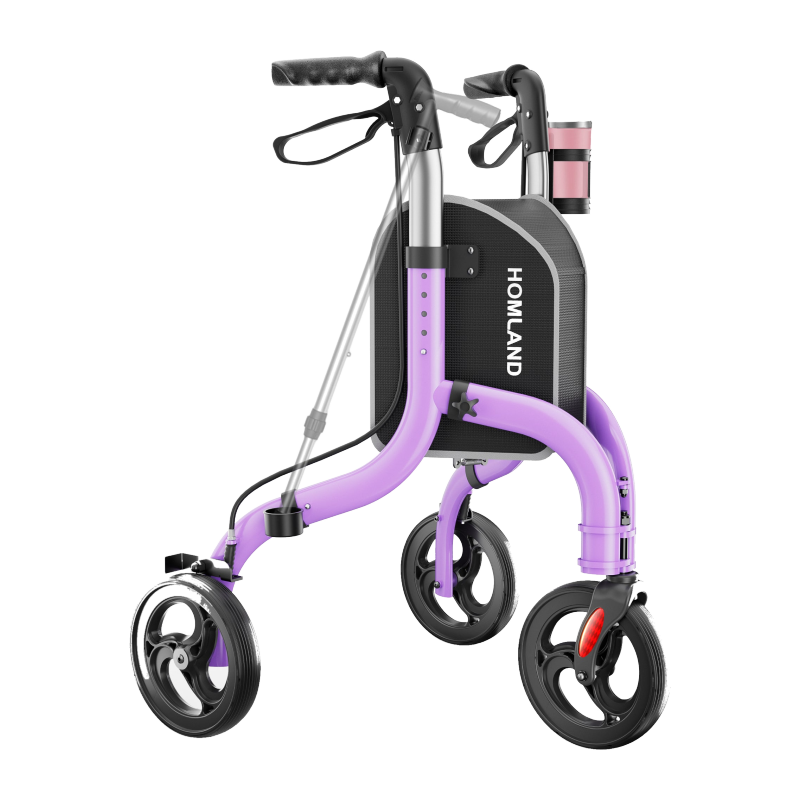

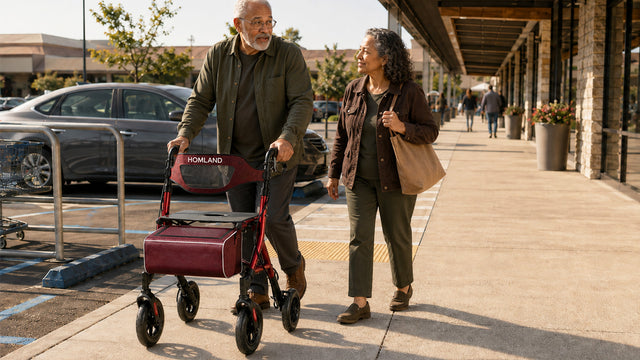
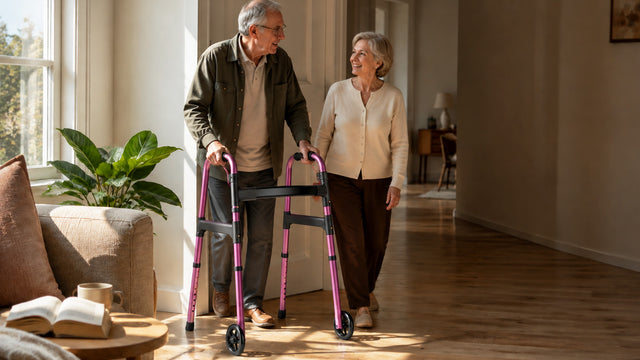

One day you're moving through your home without a second thought. The next, a broken foot, a sprained ankle, or foot surgery means the walk from the bedroom to the kitchen feels like a project. If your doctor has told you to stay off your lower leg while it heals, you're probably weighing your options — and wondering whether a knee scooter is the right call.
The short answer: for most people recovering from a below-the-knee injury, a knee scooter offers a significant upgrade over crutches in both comfort and independence. But not every knee scooter is built the same, and choosing the wrong one can make recovery harder, not easier. This guide breaks down everything you need to know — from weight limits and wheel sizes to the features physical therapists most often look for — so you or your loved one can move through recovery on your own terms, at home, with confidence.
And if you're ready to shop now: HOMLAND's knee scooter collection is FSA/HSA eligible, backed by a 1-year manufacturer warranty plus a 1-year extended warranty, and ships from a US local warehouse — so you won't wait weeks to get moving again.
What Is a Knee Scooter?
A knee scooter — also called a knee walker, knee roller, or rolling knee walker — is a wheeled mobility aid designed to keep all weight off an injured lower leg. Instead of a seat, it features a padded knee platform where you rest your injured leg, while your healthy leg pushes you forward. Handlebars with hand brakes give you steering control, and the four-wheel design keeps you stable as you move through the house, run errands, or head back to work.
What makes it so practical is how naturally it fits into daily life. You can roll to the kitchen to pour a cup of coffee, glide down the hallway to answer the door, or navigate a grocery store without exhausting your arms. When your hands need to be free — say, to carry something or type at a desk — you simply engage the brake and stand still, balanced on your good leg. It's the kind of independence that makes a real difference during what can otherwise feel like a very long few weeks.
Knee scooters are used to support recovery from a wide range of lower-leg conditions, including:
- Foot fractures and stress fractures
- Sprained or broken ankles
- Post-surgical recovery (foot and ankle procedures)
- Torn Achilles tendon
- Diabetic foot wounds and ulcers
- Below-the-knee amputations (in some cases)
It's worth noting that knee scooters are designed for below-the-knee injuries. Because the injured leg rests on the knee platform, they are not appropriate for injuries involving the knee itself or anything above it. If you're unsure whether a knee scooter suits your specific situation, a physical therapist or your treating doctor can give you a personalized recommendation.
Who Needs a Knee Scooter?
Knee scooters are a temporary aid — they're designed for the recovery window, not as a permanent mobility solution. That said, they're an excellent fit for a wide range of people, and the right candidate isn't defined by age alone. Whether you're 35 recovering from Achilles tendon surgery or 72 healing from a broken foot, the core question is the same: do you need to stay mobile without putting weight on your lower leg?
Physical therapists often recommend knee scooters for people who are mobile for significant parts of the day, have limited upper body strength or balance concerns, or simply want a safer and more comfortable way to move through the home during recovery. Crutches demand a lot — they require good arm strength, solid coordination, and ongoing effort with every single step. For someone who needs to get through an eight-hour day at home or at the office, that adds up fast.
A knee scooter tends to be the stronger choice when:
- You have limited upper body strength or arm/shoulder pain
- Balance or coordination are concerns (this is especially relevant for older adults)
- You'll be on your feet — or on your scooter — for most of the day
- You want both hands free while stationary
- Your home has reasonably flat flooring (a single level, or one main living area)
For family members helping a parent or loved one navigate this decision: the peace of mind that comes from knowing your person can move safely from room to room on their own is considerable. A knee scooter doesn't just restore mobility — it restores dignity and independence during a time when feeling capable matters enormously.
Knee Scooter vs. Crutches: Which Is Right for You?
Crutches are almost always the first option handed to someone leaving a doctor's office or emergency room with a lower-leg injury. They're familiar, inexpensive, and lightweight. But for anyone facing more than a few days of recovery — or anyone who doesn't have the arm strength and coordination to use them comfortably — they can become a source of frustration, fatigue, and even secondary injury.
A knee scooter distributes your effort very differently. Rather than demanding constant upper-body exertion to swing your weight forward with every step, you simply rest your injured leg on the padded platform and push gently with your good foot. This means your hands stay free when you're stopped, your shoulders and wrists stay out of it entirely, and you can move at something close to a normal walking pace without breaking a sweat. Physical therapists often recommend knee scooters for non-weight-bearing recovery precisely because they allow people to stay active and independent without overexertion.
Here's a straightforward side-by-side to help with the decision:
| Knee Scooter | Crutches |
|---|---|
| ✅ Hands free when stopped | ❌ Hands occupied while moving and stopped |
| ✅ Minimal upper body strain | ❌ Requires significant arm and shoulder strength |
| ✅ More stable on flat surfaces | ❌ Higher fall risk on slippery or uneven ground |
| ✅ Suitable for all-day use | ❌ Can cause underarm soreness, fatigue, and poor posture over time |
| ❌ Cannot be used on stairs | ✅ Can navigate stairs with proper technique |
| ❌ Larger footprint, less compact | ✅ Lightweight and compact for travel |
| ❌ Higher upfront cost (though FSA/HSA eligible) | ✅ Lower purchase price |
If you live in a multi-story home and regularly need to use stairs, crutches (with proper guidance) may be the safer option for stair navigation — or you may need to temporarily arrange your living situation to stay on one floor. Otherwise, for most at-home recovery situations, a knee scooter provides greater comfort, stability, and day-to-day independence.
Types of Knee Scooters
Not every knee scooter is designed for the same lifestyle. The right type for you depends on where you'll spend most of your recovery time and what your daily routine looks like.
Standard Four-Wheel Knee Scooters
The most widely used type, four-wheel knee scooters offer a stable base with two wheels in front and two in the back. They're well suited to flat indoor surfaces — hardwood floors, tile, carpet — and are the best starting point for most home-based recoveries. The wider stance reduces the risk of tipping, especially important for older adults or anyone new to using a wheeled mobility aid. Most quality models feature a tight enough turning radius (typically around 40–45 degrees) to navigate standard home hallways and doorways, though very tight spaces may occasionally require a three-point turn.
All-Terrain Knee Scooters
If you spend meaningful time outdoors — walking on a driveway, crossing a grass lawn, navigating an uneven sidewalk — an all-terrain model is worth considering. These scooters feature larger, wider wheels (often 8 inches or more) that absorb bumps and roll more smoothly over rough surfaces. The trade-off is a slightly larger footprint, which can make tight indoor navigation a bit more challenging. If your recovery involves a mix of indoor and outdoor use, look for a model that balances wheel size with overall frame compactness.
Foldable and Travel-Ready Knee Scooters
For anyone who needs to get out and about — commuting, traveling, fitting the scooter into a car trunk or an airplane overhead bin — a foldable design is a game-changer. Many modern knee scooters fold down by collapsing the steering column, making them compact enough for most car trunks. If portability matters to your recovery lifestyle, always check the folded dimensions against your trunk and storage space before buying.
Bariatric (Heavy-Duty) Knee Scooters
Standard knee scooters typically support between 250 and 350 lbs. Bariatric models are engineered with reinforced frames, wider knee platforms, and sturdier components to safely accommodate higher weight capacities — some models reach 400 lbs or more. If you need a heavy-duty option, the focus should be on finding a model that comfortably exceeds your body weight, not just meets it, so you can lean in and move with full confidence throughout the day. HOMLAND's knee scooter lineup includes options designed with higher load capacities for exactly this reason.
Understanding Knee Scooter Weight Limits
Weight capacity is one of the most important — and most frequently overlooked — considerations when choosing a knee scooter. Every model has a stated maximum load, and choosing a scooter that comfortably supports your body weight is essential for both safety and long-term durability. A scooter operating near or above its rated limit can become structurally compromised over time, affecting stability and increasing the risk of an unexpected failure during use.
Most standard knee scooters have a weight capacity ranging from 250 to 350 lbs. Heavy-duty and bariatric models can support 400 lbs or more. It's also worth knowing that your full body weight isn't entirely borne by the scooter at once — your good leg shares some of the load as it pushes and supports you — but this doesn't mean you should select a model right at the edge of your weight. A good rule of thumb: choose a model with a stated capacity that comfortably clears your body weight by a meaningful margin.
When reviewing weight capacity, also pay attention to the overall build quality of the frame. Scooters with higher weight capacities typically feature stronger steel or reinforced aluminum frames, wider knee platforms, and more robust wheel and brake components. These details contribute directly to how stable and reliable the scooter feels during extended daily use — not just on day one.
Key Features to Look For Before Buying
Beyond weight capacity and scooter type, several specific features separate a genuinely good knee scooter from one that'll have you frustrated by week two of recovery. Here's what to prioritize:
Padded Knee Platform
This is where your injured leg rests for hours at a time, so the quality of the padding matters more than most people expect. A well-padded platform distributes pressure evenly across the knee and shin, reducing soreness during extended use. Look for thick foam padding with a non-slip surface. Some models also allow the orientation of the knee pad to be adjusted for left or right leg support, which improves ergonomics and prevents your good foot from catching the frame when pushing forward.
Adjustable Knee Platform and Handlebar Heights
No two people are the same height, and a scooter that isn't sized to your body will cause discomfort and poor posture. Quality knee scooters offer independent height adjustments for both the knee rest and handlebars. The knee rest should be adjustable so your injured leg rests at a natural 90-degree angle, and the handlebars should reach roughly your waist height so you can stand upright without hunching. Tool-free or push-button adjustment mechanisms make this much easier — especially if you're already navigating recovery on one leg.
Responsive Hand Brakes
Reliable brakes are the single most important safety feature on any knee scooter. Look for hand brakes that engage smoothly and firmly — both brakes should work with equal resistance so you don't inadvertently pull to one side when stopping. A locking brake mechanism (so the scooter stays in place while you're standing still, doing tasks, or getting on and off) is an essential feature, not a luxury. Reading recent user reviews specifically for brake performance is a smart step before purchasing.
Wheel Size and Surface Compatibility
Smaller wheels (6–7 inches) roll smoothly on flat indoor surfaces and allow for a more compact frame, making them easier to maneuver in tight hallways and small bathrooms. Larger wheels (8 inches or more) handle transitions between surfaces — from hardwood to tile, over small thresholds, or out onto a patio or driveway — with less jarring and better overall stability. Consider where you'll realistically spend most of your recovery time and match the wheel size to that environment.
Portability and Folding Design
If your recovery will involve any travel — even just getting to follow-up appointments — a foldable design is genuinely valuable. Most quality knee scooters fold the steering column flat, reducing the overall height and making them easier to load into a car. Check the folded dimensions before buying, and if you'll be traveling by air, confirm that the folded size fits airline carry-on or overhead storage requirements.
Accessories and Storage
Being on a knee scooter means your hands are occupied when you're moving. A front or side basket — built-in or clip-on — lets you carry items like a phone, a water bottle, or a book without risk. Other useful add-ons include cup holders, extra knee pad covers for comfort, and phone holders. These small touches can make a meaningful difference in how normal daily life feels during a weeks-long recovery.
Explore the full range of features available in HOMLAND's knee scooter collection, engineered with tool-free assembly and adjustable fit for home use.
How to Set Up and Use a Knee Scooter Safely
Getting the setup right before your first ride is essential. A poorly adjusted scooter can lead to knee discomfort, back strain, and poor posture — problems that are entirely avoidable with five minutes of proper fitting. Physical therapists emphasize this consistently: the scooter should feel like a natural extension of your body, not something you're fighting to control.
Step 1: Adjust the knee rest height. Stand upright and bend your injured leg to a 90-degree angle at the knee. Have someone measure the distance from the bottom of your bent knee to the floor, then adjust the knee rest to match that measurement. When positioned correctly, your knee rests comfortably on the pad and your hips remain level — you shouldn't feel like you're hiking one hip up higher than the other.
Step 2: Adjust the handlebar height. The handlebars should sit at approximately your waist level when you're standing upright on your good leg. If they're too low, you'll hunch forward and strain your back. If they're too high, your arms will feel cramped and you'll have less steering control. The goal is a relaxed, upright posture with your arms at a comfortable angle.
Step 3: Mount carefully. Always lock the brakes before getting on. Position yourself beside the scooter with your injured side closest to the knee platform. Grip both handlebars, then gently lower your injured leg onto the pad. Check that your knee rests at a 90-degree angle and your hips are even before releasing the brakes.
Step 4: Start slowly. Use your good foot to push forward in small, controlled strides. Keep both hands on the handlebars at all times while moving. Give yourself a day or two of practice in an open area at home before navigating tighter spaces or heading outdoors.
Step 5: Dismount with care. Come to a full stop, lock the brakes, and keep your hands on the handlebars as you gently move your injured leg off the pad. Let your good foot take your weight fully before releasing the handlebars.
Safety Tips for Everyday Use
A knee scooter is a wheeled device, which means it responds to speed, terrain, and weight distribution. A few consistent habits will keep you safe throughout your recovery:
- Keep your speed at a comfortable walking pace. Moving too fast increases the risk of tipping, especially on turns. A controlled pace protects both you and the people around you.
- Slow down before every turn. Engage the brakes as you approach corners, even familiar ones. Most knee scooters turn up to 40–45 degrees; for tighter spaces, a three-point turn is safer than trying to force a sharp angle.
- Keep the brake engaged when stopped. Even on flat surfaces, an unbraked scooter can roll if bumped. Locking the brake when you're stationary — especially while doing tasks with both hands — is a habit worth building from day one.
- Use a basket or backpack for carrying items. Reaching out with one arm while moving puts you off-balance. A mounted basket keeps your hands free and your center of gravity stable.
- Stay upright — shoulders back, body centered. Slouching forward or leaning to one side puts unnecessary strain on your back and reduces stability. Think of it as standing tall, just with wheels.
- Control speed on downhill slopes. Use both hand brakes and your good foot as needed to maintain a slow, steady pace going downhill. Moving too quickly on a slope is one of the most common causes of scooter-related falls.
- Never use a knee scooter on stairs. Stairs are a hard no. If your home has stairs between your bedroom and the main floor, talk to your physical therapist about temporarily rearranging your recovery space.
- Don't overload the handlebar or scooter frame. Hanging heavy bags from the handlebars makes the scooter top-heavy and far more likely to tip. Use a proper basket or wear a light backpack instead.
Renting vs. Buying: How to Decide
Because knee scooters are typically used for a defined recovery period, it's worth pausing before automatically buying one outright. The right choice depends on three main factors: how long you'll need it, what your budget looks like, and what features matter most to your recovery.
If you're facing a short recovery window — say, four to six weeks for a minor fracture or straightforward procedure — renting can be a practical way to get a quality scooter without the full purchase cost. Rental programs typically run week-to-week or month-to-month, making them a flexible option when the timeline is uncertain.
That said, purchasing often makes better sense for recoveries lasting two months or more. Over a longer period, the cost-per-day of ownership is usually lower than rental fees, and you have full control over which model you use, how it's maintained, and when you're done with it. Buying also means you can return to it if re-injury or future surgery requires another recovery period — something no one plans for, but worth keeping in mind.
The quality consideration matters here too. Rental programs work with whatever their current fleet offers. Buying gives you the option to choose a model with the exact features — knee pad comfort, weight capacity, foldability, turning radius — that fit your specific situation and living space. For many people, that control is worth the investment. HOMLAND knee scooters are available at competitive pricing with FSA/HSA eligibility, making the cost of ownership lower than it might first appear.
Insurance, FSA, and HSA Coverage
One of the most common questions people ask before purchasing a knee scooter is whether their insurance will cover it. The answer depends on your specific plan, but here's what's generally true:
FSA and HSA eligibility: Knee scooters are eligible for purchase using Flexible Spending Account (FSA) and Health Savings Account (HSA) funds. These accounts let you set aside pre-tax money for qualifying medical expenses, effectively reducing the out-of-pocket cost of your scooter. HOMLAND knee scooters are FSA/HSA eligible, and you can use your FSA or HSA card at checkout.
Insurance coverage: Knee scooters are classified as durable medical equipment (DME) and carry the HCPCS code E0118 (Crutch Substitute, Lower Leg Platform With or Without Wheels). Coverage through Medicare, Medicaid, or private insurance varies significantly by plan. Medicare, for example, does not consistently cover knee scooters in all cases. If you want to pursue reimbursement, contact your insurance provider directly and ask about your DME benefit. A doctor's prescription or written recommendation can strengthen a reimbursement claim, even if one isn't required to purchase the scooter outright.
No prescription required to buy: You do not need a prescription to purchase a knee scooter. They can be bought directly — online, in medical supply stores, or on Amazon — without prior insurance approval or a doctor's order. The prescription becomes relevant only if you're pursuing insurance reimbursement.
HOMLAND knee scooters ship fast from a US local warehouse, come with a 1-year manufacturer warranty plus a 1-year extended warranty, and are authorized by licensed Doctors of Physical Therapy. You can explore the full collection at homland.com/collections/knee-scooter, and browse all HOMLAND mobility products at homland.com/collections/all.
Find the Right Knee Scooter for Your Recovery
Choosing the right knee scooter comes down to a clear picture of your recovery: how long it will last, where you'll spend most of your time, how much you weigh, and which features will genuinely make your daily life easier. Weight capacity, knee pad comfort, adjustability, wheel size, and braking quality are the features that matter most — not just the price tag or the brand name on the frame.
For most people recovering at home, a well-built four-wheel knee scooter with tool-free height adjustments, a thick padded knee platform, and reliable locking brakes will cover everything they need. If you're heavier, need to go outdoors, or are planning to travel, a bariatric or all-terrain model with added portability features may be the better fit. Either way, the goal is the same: staying mobile, staying independent, and getting back to normal life as smoothly as possible — at home, not in a hospital.
HOMLAND's knee scooters are designed with exactly that goal in mind. Backed by 20+ years of manufacturing experience, authorized by licensed physical therapists, FSA/HSA eligible, and supported by a two-year total warranty, they're built to make recovery feel less like a limitation and more like a manageable chapter.
Ready to Find Your Fit?
Browse HOMLAND's full knee scooter collection — FSA/HSA eligible, fast US shipping, and backed by a two-year total warranty. Have questions about which model is right for your recovery? Our team is here to help.