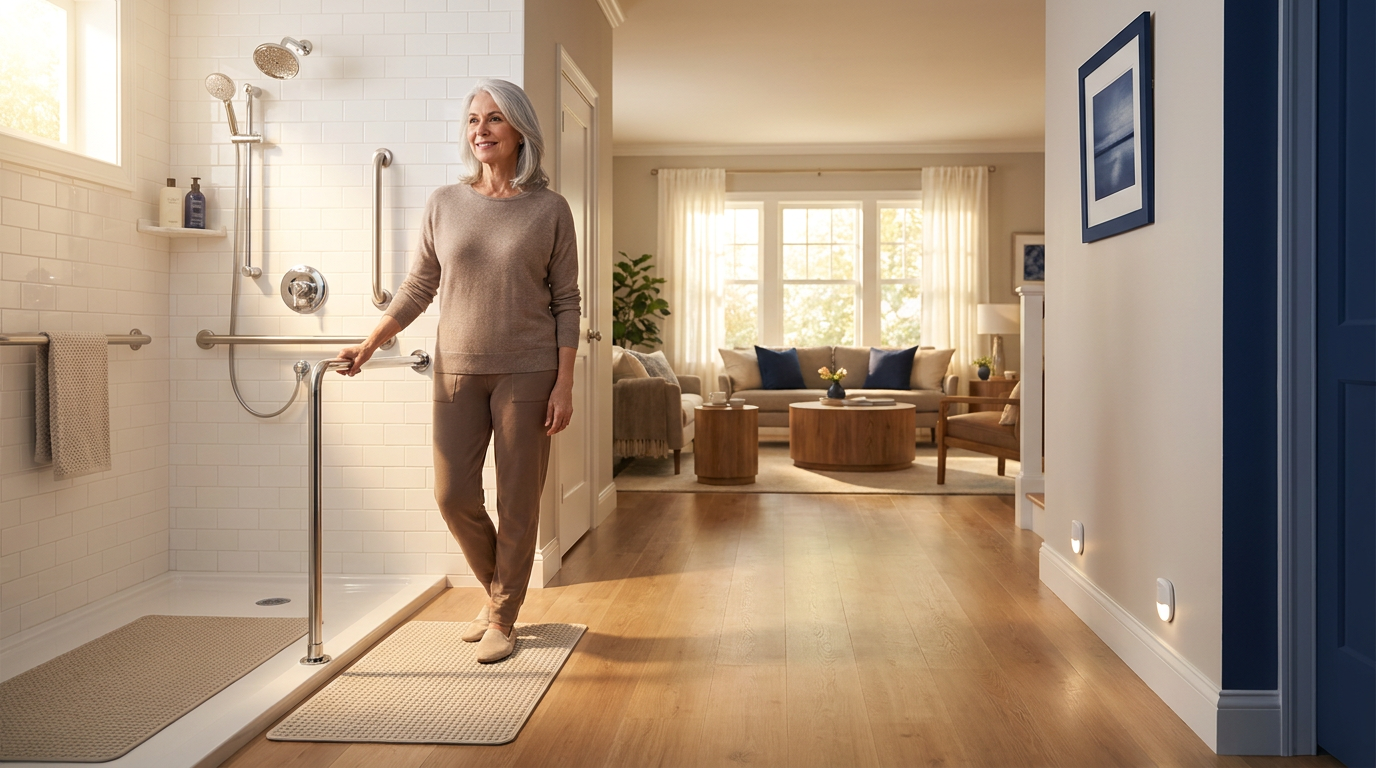

Stairs are one of the most common places where falls happen at home — and for older adults, a fall on a staircase can mean far more than a bruise. According to the CDC, falls are the leading cause of injury-related deaths among adults 65 and older, and stairways are among the highest-risk spots in any home. Yet millions of seniors navigate stairs every single day, often without the right support in place.
The encouraging truth is that stair safety doesn't require a home renovation or a dramatic lifestyle change. The right combination of handrails, stair treads, good lighting, and — when needed — a stair lift can transform a staircase from a daily source of anxiety into a passage you move through with confidence. Whether you're a senior who wants to keep living independently in your two-story home, or an adult child who lies awake wondering if Mom made it upstairs safely, this guide is for both of you.
Below, you'll find practical, physical therapist-informed advice on every major dimension of stair safety — from choosing and installing the right handrail, to deciding if a stair lift makes sense, to the small daily habits that quietly reduce fall risk over time.
Why Stairs Are a Leading Fall Risk for Older Adults
Climbing or descending a staircase demands more from the body than most people realize: balance, lower-body strength, depth perception, and the ability to shift weight smoothly from one foot to the other. As we age, each of these abilities can gradually decline. Muscle weakness in the legs, changes in vision, slower reaction times, and the side effects of common medications can all make a staircase that felt perfectly manageable at 60 feel genuinely precarious at 75.
Physical therapists often point out that going downstairs is actually riskier than going up. Descending requires eccentric muscle control — the kind where your muscles lengthen under load — which is one of the first things to weaken with age. Add a dim hallway light or a slick wooden step, and the risk compounds quickly. Understanding why stairs are dangerous is the first step toward making them safer, and it starts with the most fundamental safety feature in any staircase: the handrail.
Handrails: Your First Line of Defense
A well-installed handrail can be the difference between a close call and a serious fall. It gives you something solid to grip before a stumble becomes a fall — and it helps distribute the effort of climbing across both the arms and legs, reducing fatigue on longer staircases. Physical therapists frequently recommend that older adults use their handrails consistently, not just when they feel unsteady, because the habit builds a safety reflex that kicks in automatically when it's needed most.
What Makes a Good Handrail?
Not all handrails are created equal. A decorative wrought-iron rail that wobbles under pressure offers false confidence more than real safety. When evaluating or upgrading your handrail, physical therapists and home safety experts look for these qualities:
- Secure mounting: The rail should be anchored into wall studs, not just drywall. It should support at least 200 lbs of lateral and downward force without flexing.
- Continuous grip surface: Ideally, the rail runs the full length of the staircase without gaps, so you can slide your hand along it without ever losing contact.
- Graspable diameter: Building codes generally recommend a diameter of 1.25 to 2 inches — wide enough to grip firmly, narrow enough to wrap your fingers around.
- Rails on both sides: For seniors, having a handrail on both sides of the staircase provides maximum support and accommodates the hand preference that naturally varies when going up versus down.
- Extensions at the top and bottom: A rail that extends 12 inches past the top and bottom step gives you something to hold before and after the staircase, which is exactly when many falls occur.
If your current handrail fails any of these criteria, it's worth addressing sooner rather than later. A licensed contractor or occupational therapist can assess your staircase and recommend the right fix — often a straightforward upgrade that takes less than a day to install.
Grab Bars vs. Handrails: What's the Difference?
People often use these terms interchangeably, but they serve slightly different purposes. Handrails run parallel to the slope of a staircase and are designed for continuous guidance as you move up or down. Grab bars are typically mounted vertically or at an angle at specific transition points — such as at the top of the stairs, at a landing, or near a door. Both can be valuable, and in many homes, the ideal setup includes both: a full-length handrail along the staircase and a vertical grab bar at the top landing to help with that final step and the pivot to walk away.
Stair Lifts: When Handrails Aren't Enough
For some seniors, a handrail — no matter how well-installed — simply isn't enough. If you or your loved one has significant balance issues, severe joint pain, a recent hip or knee replacement, or a condition like Parkinson's disease, the physical act of climbing stairs may carry too much risk regardless of what you hold onto. This is where a stair lift becomes worth serious consideration.
A stair lift is a motorized chair that travels along a rail mounted to the staircase, carrying the user from floor to floor without requiring them to walk the steps at all. Modern stair lifts are designed to fit straight and curved staircases, fold away neatly when not in use, and include safety features like seatbelts, swivel seats, and obstruction sensors. For families committed to aging in place in a multi-story home, a stair lift can be one of the most meaningful investments in long-term independence.
Is a Stair Lift Right for Your Situation?
The decision to install a stair lift is personal, and it often makes sense to consult with a physical therapist or occupational therapist before committing. Here are the scenarios where a stair lift is most commonly recommended:
- Recovery from a hip, knee, or back surgery where stair climbing is temporarily contraindicated
- Chronic conditions that cause significant shortness of breath or fatigue on exertion
- Progressive neurological conditions that affect balance and gait
- A recent fall on the stairs, or a near-miss that has created a fear of stair use
- Lower-limb weakness that makes descent particularly unsafe, even with a handrail
It's also worth noting that stair lifts may qualify as a medical expense for FSA/HSA reimbursement depending on your provider — worth checking before assuming you'll pay entirely out of pocket.
Non-Slip Treads and Lighting: The Unsung Heroes
Ask any physical therapist what two things they'd change first in a senior's staircase, and the answer is almost always the same: better light and better traction. These two factors are behind a disproportionate number of stair falls — and they're also among the easiest and most affordable fixes available.
Non-Slip Stair Treads
Polished hardwood, smooth tile, and even low-pile carpet can become dangerously slick — especially in socks. Adhesive non-slip stair treads are available in rubber, carpet-textured, and transparent varieties, and they can be applied to virtually any step surface in under an hour. The key is to cover the full width of each step, keep them firmly adhered (check edges regularly for peeling), and replace them when the texture starts to wear down. For homes with carpet runners, make sure the runner is secured with a non-slip pad and that no edges are lifted or curling.
Lighting That Actually Helps
Overhead lighting is often not enough on a staircase. A bright ceiling fixture can cast shadows directly onto the steps, making it hard to judge depth — especially for those whose low-light vision has changed with age. The most effective stair lighting strategies layer multiple sources:
- Step lighting: Small LED fixtures mounted into the wall beside each step illuminate the tread directly.
- Motion-sensor switches: These ensure the light is on before you take a single step, even at 3 a.m.
- Glow-in-the-dark tape: Applied to step edges, this simple addition can be genuinely life-saving during nighttime trips.
- High-contrast edge marking: For those with low vision, a strip of brightly colored tape along the front edge of each step creates a clear visual boundary.
Daily Habits That Reduce Stair Fall Risk
Physical modifications to the staircase matter enormously, but habits matter just as much. Physical therapists who specialize in fall prevention consistently emphasize that how you use a staircase is as important as how it's equipped. A few practices, repeated consistently, can significantly reduce fall risk over time.
- Always use the handrail. Make it a non-negotiable rule, not just something you do when you feel unsteady. The habit creates muscle memory that works even when your mind is elsewhere.
- Never carry items that block your view of the steps. If you need to bring something upstairs, use a bag over your shoulder or make two trips rather than carrying a basket in both arms.
- Take one step at a time. Rushing on stairs — or trying to take two steps at once — dramatically increases the risk of a misstep.
- Pause before the first step and the last. Transitions at the top and bottom of a staircase are where many falls happen. A brief stop to orient yourself reduces that risk.
- Wear proper footwear. Slippers without grip, bare feet, and loose socks are a significant fall risk on stairs. Supportive shoes with non-slip soles are the safest choice inside the home.
- Check medications regularly. Dizziness and balance disruption are common side effects of many medications. If you notice these symptoms, speak with your doctor — especially before navigating stairs.
Mobility Aids That Support Safe Movement Around the Home
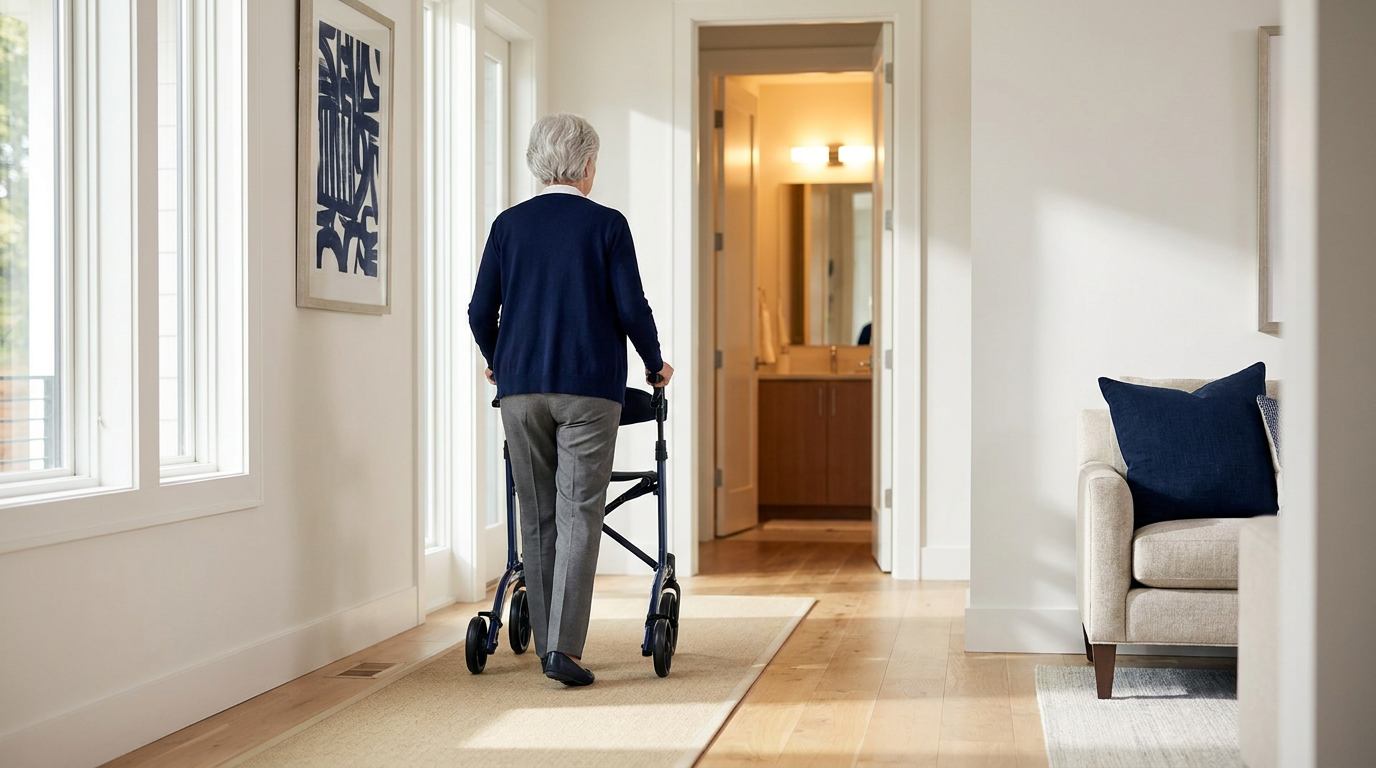
Stair safety doesn't exist in isolation. What happens on the stairs is connected to how confidently and safely someone moves through the rest of their home. A person who feels unsteady walking to the staircase is more likely to approach the first step with hesitation — and hesitation on stairs can itself contribute to a fall. Supporting overall mobility and balance throughout the day is part of a complete stair safety strategy.
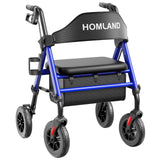
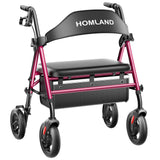
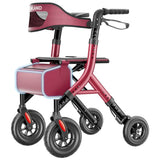
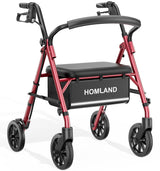
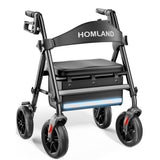
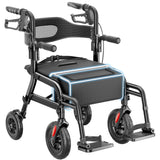
HOMLAND's rolling walkers and standard walkers are designed to provide stable, confident movement through hallways, living rooms, and kitchens — giving users the balance support they need to approach the staircase in a steadier state. For those recovering from lower-limb injuries or surgery, a knee scooter can be a practical alternative to weight-bearing during the period when stair use is most restricted.
Safety also extends to the bedroom. Getting in and out of bed — especially at night when the urge to use the bathroom sends someone toward the staircase in a drowsy state — is one of the riskiest moments of the day. HOMLAND's bed rails help users rise safely and orient themselves before walking, reducing the chance of a nighttime stumble before they've even reached the stairs. All HOMLAND products are FSA/HSA eligible, backed by a 1-year manufacturer warranty plus a 1-year extended warranty, and ship from a US local warehouse for fast delivery when you need support quickly.
A Caregiver's Quick-Start Guide to Stair Safety
If you're an adult child or family caregiver helping a parent or loved one stay safely at home, stair safety is one of the highest-leverage areas to focus on early. Here's a practical starting point for a stair safety assessment:
- Walk the stairs yourself, slowly. Notice what feels uneven, slippery, or inadequately lit. Look at every step as if for the first time.
- Test the handrail. Push laterally and downward with your full body weight. If it moves, it needs to be re-anchored before anything else.
- Check lighting at night. Stand at the top and bottom of the staircase after dark with only the existing lights on. If you struggle to clearly see the step edges, the lighting needs improvement.
- Look for clutter. A single item left on a step — a shoe, a book, a pet toy — can cause a fall. Establish a household rule that stairs are always clear.
- Ask your loved one how the stairs feel. Fear of stairs is often underreported. If they admit to feeling nervous, that's clinically significant and worth discussing with their doctor or a physical therapist.
- Consider a professional home safety assessment. Many physical therapists and occupational therapists offer in-home evaluations and can identify risks you might overlook as a family member.
Frequently Asked Questions
Do I really need handrails on both sides of the stairs?
Yes, and physical therapists strongly recommend it. Having a rail on both sides means you always have support within reach regardless of which hand is stronger or which direction you're turning. It's especially important for seniors who have had a stroke or injury that affects one side of the body more than the other.
At what point should someone consider a stair lift instead of just a handrail?
If navigating the stairs causes significant pain, leaves you out of breath, has resulted in a fall or near-fall in the past year, or if a healthcare provider has recommended limiting stair use, it's time to have a serious conversation about a stair lift. A physical therapist can help assess whether stair climbing is safe given a person's current strength and balance profile.
Are non-slip treads enough, or do I need a carpet runner?
Either can be effective when properly installed. Non-slip adhesive treads work well on hard surfaces and are easy to replace. Carpet runners provide full-step coverage and cushioning. The key is that whatever solution you choose must be firmly secured — a loose carpet runner is more dangerous than a bare wood step.
What footwear is safest for using stairs at home?
Supportive shoes with rubber, non-slip soles are the safest option. Avoid bare feet, socks without grip pads, and open-backed slippers on stairs. If someone prefers not to wear shoes indoors, grip socks (sometimes called non-slip socks) are a reasonable compromise — look for models with silicone grips covering the full sole.
Can HOMLAND's mobility products help with stair-related fall prevention?
HOMLAND's walkers, bed rails, and other mobility aids support safe movement throughout the home — which contributes to better balance and confidence when approaching and using stairs. While these products aren't stair-specific, a person who moves more confidently and stably through their home is better prepared to navigate stairs safely. Browse the full HOMLAND product collection to find tools that match your needs.
Safety on the Stairs Starts Today
Stairs don't have to be a daily source of worry. With the right handrails in place, good lighting, secure non-slip treads, and habits that keep safety at the forefront, most older adults can continue using their staircases comfortably and independently for years. For those who need a more significant solution, stair lifts offer a path to full access without the physical demands of climbing.
The goal, as always, is not to make a home feel like a hospital — it's to make it feel like home. A place where you move on your own terms, at your own pace, with the confidence that comes from knowing your environment is set up to support you. That's what stair safety done right actually looks like: not restrictive, but freeing.
If you're supporting a loved one through this process, remember that the best stair safety setup combines physical modifications, the right mobility tools, and ongoing conversation. Small changes made early make the biggest difference — and you don't have to figure it all out alone.
Have Questions? We're Here to Help.
Whether you're outfitting a home for safer daily living or looking for the right mobility support after surgery, HOMLAND's team is ready to help you find the right solution. All HOMLAND products are authorized by licensed Doctors of Physical Therapy, FSA/HSA eligible, and backed by a 2-year total warranty.