
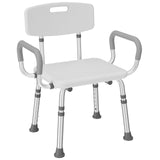
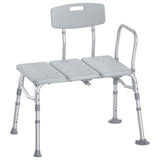
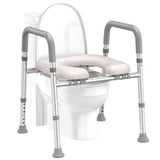
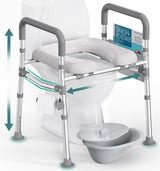
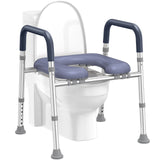
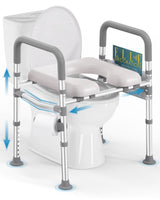
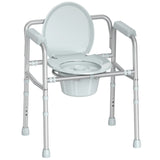
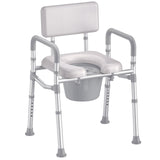
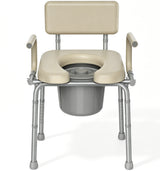



A drop-arm commode is a bedside toilet-chair whose armrests lower out of the way, so a person can slide sideways onto the seat instead of stepping around a fixed arm. The movable arm makes side transfers — to and from a bed or wheelchair — far easier and safer for anyone who can’t stand for long.
In short: a commode with an arm that drops down, so you can slide straight across onto the seat from a bed or wheelchair.
What Is a Drop-Arm Commode?
A drop-arm commode is a type of bedside commode built for easier transfers. Like any commode, it’s a sturdy chair with a toilet seat and a removable bucket underneath, needing no plumbing. What sets it apart is that one or both armrests can be released and lowered — or “dropped” — so the side of the seat opens up.
That matters because moving onto a commode is often the hardest part. With a fixed-arm chair, a person has to stand, turn, and lower down over the arm. With a drop-arm design, the arm gets out of the way so the person can slide horizontally across from a bed or wheelchair at nearly the same height — a much smaller, steadier movement. The arm then lifts back up to give support while seated.
Because it makes side-to-side transfers so much easier, a drop-arm commode is a common choice for people with limited standing ability or those who use a wheelchair. It’s closely related to a standard bedside commode; the drop-arm feature is the key upgrade.
Who Is It For and When Is It Used?
A drop-arm commode is a good fit for someone who:
- Transfers sideways between a bed, wheelchair, and commode rather than standing and turning.
- Can’t stand for long or bear much weight, so a slide-across transfer is safer.
- Needs a caregiver’s help with transfers and would benefit from a clear, open side.
Transfers are a well-known moment for falls and strain — standing on unsteady legs, twisting, and lowering down all at once. Falls are a serious concern as we age: the CDC reports that about 1 in 4 adults aged 65 and older falls each year, and falls are the leading cause of injury in this age group.1 By letting the person move straight across instead of up-turn-and-down, a drop-arm commode removes much of the risk from that moment.
For a caregiver, the lowered arm makes assisting far easier and safer on their own back too — a loved one can be supported in a smooth sideways slide rather than lifted over a fixed armrest.
Drop-Arm Commode vs Standard Commode: What’s the Difference?
Both are bedside toilet-chairs; the difference is the armrest:
| Drop-Arm Commode | Standard Commode | |
|---|---|---|
| Armrests | Lower out of the way for transfers | Fixed in place |
| Getting on | Slide sideways from a bed or wheelchair | Stand, turn, and lower over the arm |
| Best for | Limited standing; wheelchair users; caregiver-assisted transfers | Those who can stand and turn to sit |
| Support seated | Arm lifts back up for support | Firm support throughout |
The simple guide: if the person can stand, turn, and lower onto a seat, a standard commode is simpler and does the job. If they transfer sideways from a bed or wheelchair, or can’t stand for long, the drop-arm design makes that move far safer and easier — for the user and anyone helping.
How to Choose and Use a Drop-Arm Commode
A few things worth checking before you buy:
- 1Smooth, secure arm mechanism. The arm should drop and lock back up easily but hold firmly in place when raised.
- 2Transfer height match. Look for adjustable-height legs so the seat can be set level with the bed or wheelchair for a smooth sideways slide.
- 3Sturdy seated support. When raised, the arms should give solid support for sitting and standing.
- 4Easy-to-clean bucket. A lidded, easy-to-carry bucket keeps the bedside-toilet role hygienic.
- 5Sturdiness. For heavier users, choose a reinforced, heavy-duty or bariatric model built for extra support rather than focusing on a single figure.
To use it safely, position the commode close alongside the bed or wheelchair and set the seat to a matching height. Lower the arm on the transfer side, make sure the chair is steady, then slide across onto the seat. Raise and lock the arm again for support. Always follow your care team’s guidance on safe transfers.
HOMLAND drop-arm commodes are engineered for tool-free assembly and adjustable heights, and are FSA/HSA eligible, backed by a US local warehouse for fast delivery and a manufacturer warranty.
Frequently Asked Questions
A drop-arm commode is a bedside toilet-chair with armrests that lower out of the way. This lets a person slide sideways onto the seat from a bed or wheelchair instead of standing and stepping over a fixed arm, making transfers easier and safer. The arm then raises to give support while seated.
On a standard commode the armrests are fixed, so the person stands, turns, and lowers onto the seat. On a drop-arm commode the arm lowers out of the way, so the person can slide straight across from a bed or wheelchair. Drop-arm models suit those who can't stand and turn easily.
A drop-arm commode is especially helpful for people who transfer sideways rather than standing — such as wheelchair users or those who can't stand or bear weight for long. It's also easier for caregivers, since a loved one can be supported in a smooth sideways slide instead of lifted over a fixed arm.
Position the commode right beside the bed or wheelchair at a matching seat height, lower the arm on the transfer side, and make sure the chair is steady. Then slide across onto the seat rather than standing up. Raise and lock the arm again for support, and follow your care team's guidance on safe transfers.
- Centers for Disease Control and Prevention (CDC) — Facts About Falls. www.cdc.gov/falls/data-research/facts-stats/index.html