
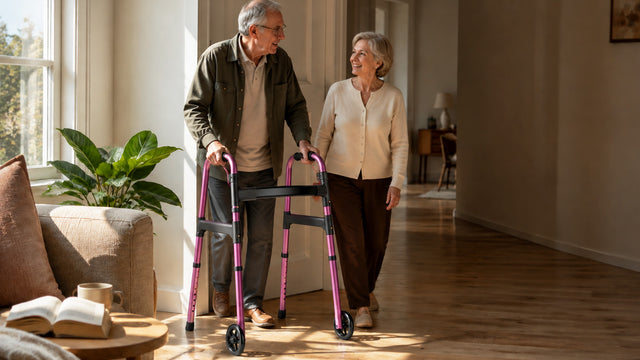
A gait belt is a sturdy fabric strap that fastens snugly around a person’s waist, giving a caregiver a secure handhold to steady them while standing, walking, or transferring between a bed, chair, or wheelchair. It is a transfer and safety aid — held by the helper, not the user — that makes assisting someone safer for both people.
In short: a waist strap a caregiver holds to safely steady and support a loved one during standing, walking, and transfers.
What Is a Gait Belt?
A gait belt is a wide, reinforced band — usually canvas or nylon — that buckles firmly around the waist of the person being helped. Rather than something the user leans on themselves, it is a handhold for the caregiver: a place to hold on that is far safer and more secure than grabbing an arm, a hand, or clothing.
With a good grip on the belt, a caregiver can help a loved one rise from a chair, stay steady on their feet, walk a short distance, or move (“transfer”) from a bed to a wheelchair. The belt keeps the helper close to the person’s center of gravity, so they can guide and steady them, and catch or lower them gently if they start to lose balance.
Most gait belts have a metal or quick-release buckle and are adjustable to fit different waists over clothing. Some add padded handles or loops along the belt, which give the caregiver an easier, more comfortable grip.
Who Is It For and When Is It Used?
A gait belt is mainly a tool for caregivers helping someone who needs hands-on support to stand, walk, or transfer safely. It is used when a person:
- Can bear some weight on their legs but is unsteady and needs a helper close by for balance.
- Is moving between a bed, chair, wheelchair, or commode and needs guiding through the transfer.
- Is regaining strength after surgery or illness and practicing walking with a caregiver’s support.
For the caregiver, a gait belt is about protecting both people. Reaching under an arm or pulling on a hand can hurt the helper’s back and the loved one’s shoulder — a belt gives a firm, central handhold instead, so assisting feels controlled rather than precarious. Falls are a serious concern for older adults: the CDC reports that about 1 in 4 adults aged 65 and older falls each year, and falls are the leading cause of injury in this age group.1 A gait belt is a simple way to make the risky moments — standing up, turning, sitting down — steadier and safer.
For the person being helped, a belt used well preserves dignity: it lets them do as much of the movement as they can, with support there only when it is needed.
How to Choose and Use a Gait Belt
A few things worth checking before you buy:
- 1Length and fit. Choose a belt long enough to wrap the waist over clothing with room to fasten securely; many are adjustable.
- 2Buckle type. A quick-release or secure metal buckle should hold firmly yet come undone easily when needed.
- 3Handles. Padded handles or loops give the caregiver a comfortable, controlled grip and are easier on the hands.
- 4Material and washability. A durable, easy-to-clean fabric holds up to daily use.
- 5Sturdiness. For larger users, choose a reinforced, heavy-duty belt built for extra support rather than focusing on a single number.
To use it safely: fasten the belt snugly around the waist over clothing — snug enough that it will not ride up, with room to slip a flat hand underneath. The caregiver grips the belt (or its handles) with an underhand hold, stays close, bends at the knees rather than the back, and guides the person through the movement. Never use a gait belt to lift someone’s full weight, and always follow your care team’s guidance on safe transfers. It is not meant for people who cannot bear any weight on their legs.
Frequently Asked Questions
A gait belt is a sturdy fabric strap that fastens around a person's waist to give a caregiver a secure handhold while steadying them during standing, walking, or transfers between a bed, chair, or wheelchair. It is held by the helper, not the user, and makes assisting someone safer for both people.
"Gait" refers to the way a person walks, so a gait belt is a belt used to help support and steady someone's walking and movement. In practice it is a waist strap a caregiver holds to guide and stabilize a loved one during standing, walking, and transfers.
By definition, a gait belt is a transfer and safety device — a reinforced waist strap that provides a caregiver with a firm handhold to assist a person in standing, walking, or moving between surfaces. It improves safety and control during transfers and reduces strain on both the caregiver and the person being helped.
Fasten the belt snugly around the waist over clothing, snug enough that it will not ride up but with room to slip a flat hand underneath. Grip the belt with an underhand hold, stay close, and lift with your legs, not your back. Use it to steady and guide, never to lift someone's full weight, and follow your care team's guidance.
- Centers for Disease Control and Prevention (CDC) — Facts About Falls. www.cdc.gov/falls/data-research/facts-stats/index.html