

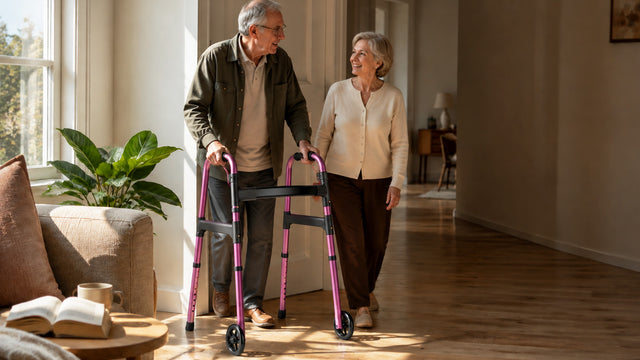

Choosing between a rollator and a standard walker is one of those decisions that sounds simple until you're actually standing in front of both options wondering which one fits your life. Maybe you're recovering from a hip replacement and your physical therapist mentioned both. Maybe you're helping a parent regain confidence after a fall. Either way, the right choice isn't about picking the fancier device — it's about finding the one that keeps you or your loved one moving safely, comfortably, and independently at home and beyond.
This guide breaks down exactly how rollators and standard walkers differ, who each one suits best, and what real-world scenarios tip the scales one way or the other. By the end, you'll have a clear picture of which mobility aid belongs in your home — not a hospital, your home.
Good news for caregivers and buyers: all HOMLAND mobility aids are FSA/HSA eligible, backed by a 1-year manufacturer warranty plus a 1-year extended warranty, and ship from a US local warehouse for fast delivery. So once you know what you need, getting it is the easy part.
What Is a Standard Walker?
A standard walker is a four-legged frame — typically made from lightweight aluminum — that you lift and place forward with each step. There are no wheels involved. You pick it up, move it ahead, and then step into it. That lift-and-place motion is exactly what makes it so stable: all four legs are on the ground whenever you put weight on it, giving you a completely solid base of support.
Standard walkers are ideal when maximum stability is the top priority. Think of someone who has just had surgery, is dealing with significant balance challenges, or needs to bear weight carefully on one leg. The deliberate, controlled pace they require is a feature, not a limitation — it forces a slow, steady gait that reduces the risk of stumbling. Some models, including wheeled variants with two front wheels and two back rubber tips, offer a middle-ground option for people who need stability but find a full lift too tiring.
HOMLAND's standard walker collection is engineered with tool-free assembly and adjustable height settings, so the fit is right from the moment it arrives — no clinic visit required to get set up.
What Is a Rollator?
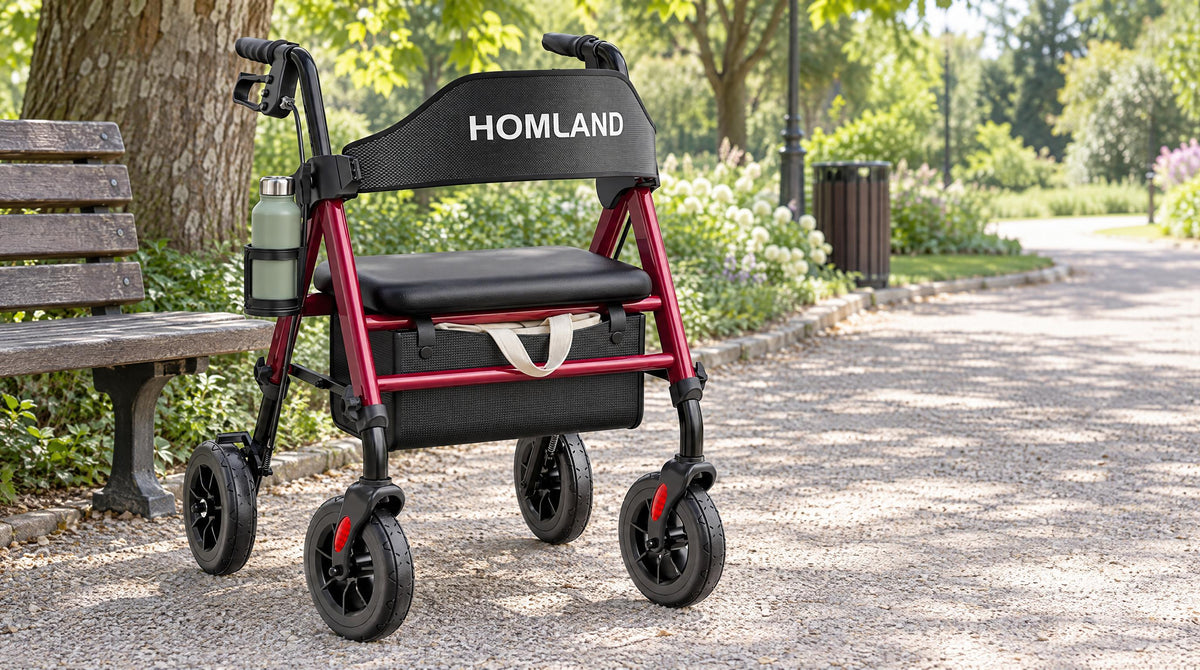
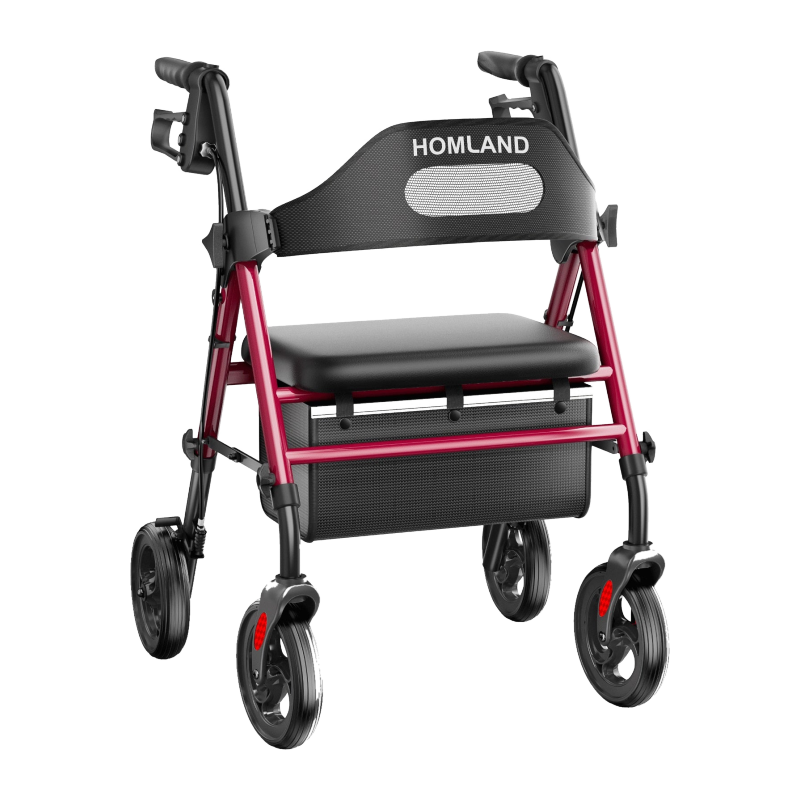
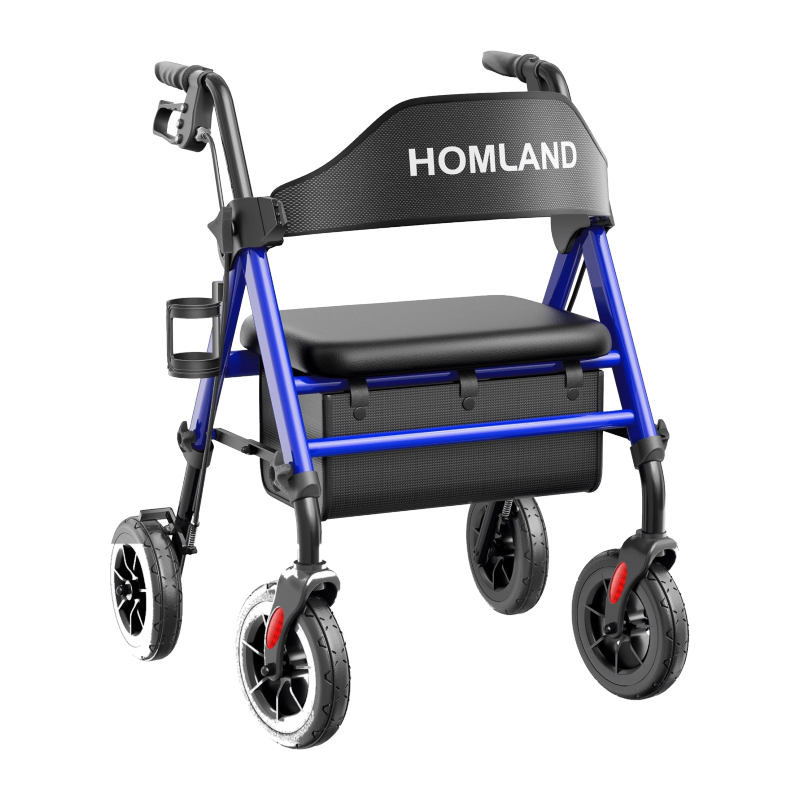
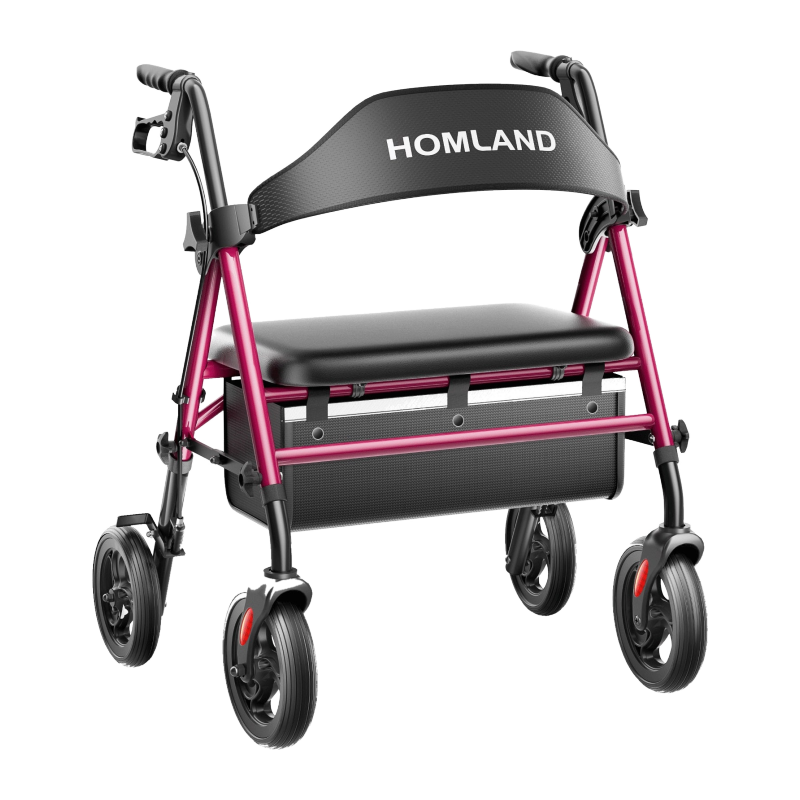
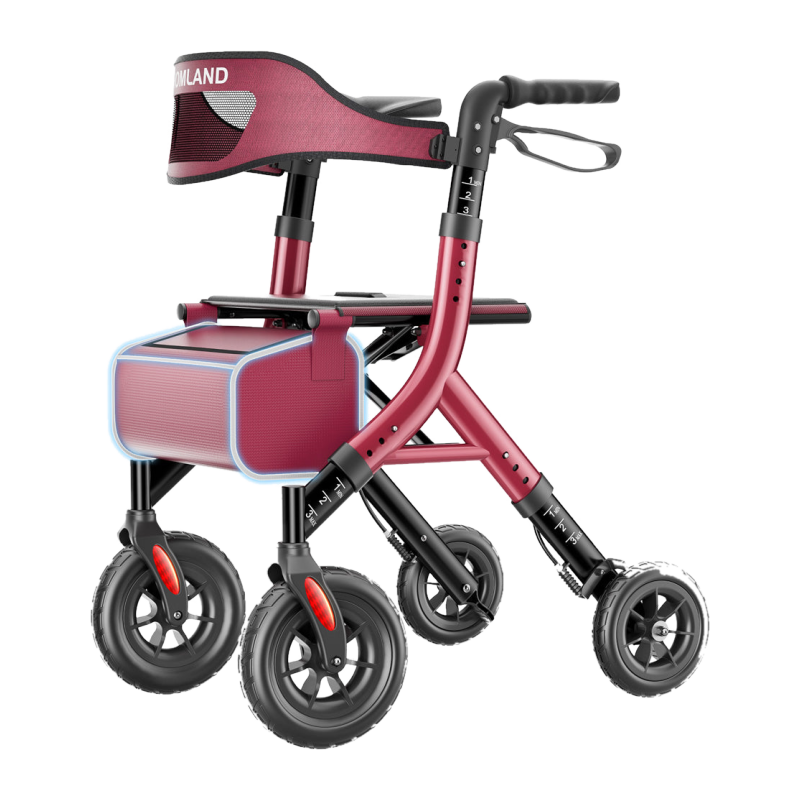
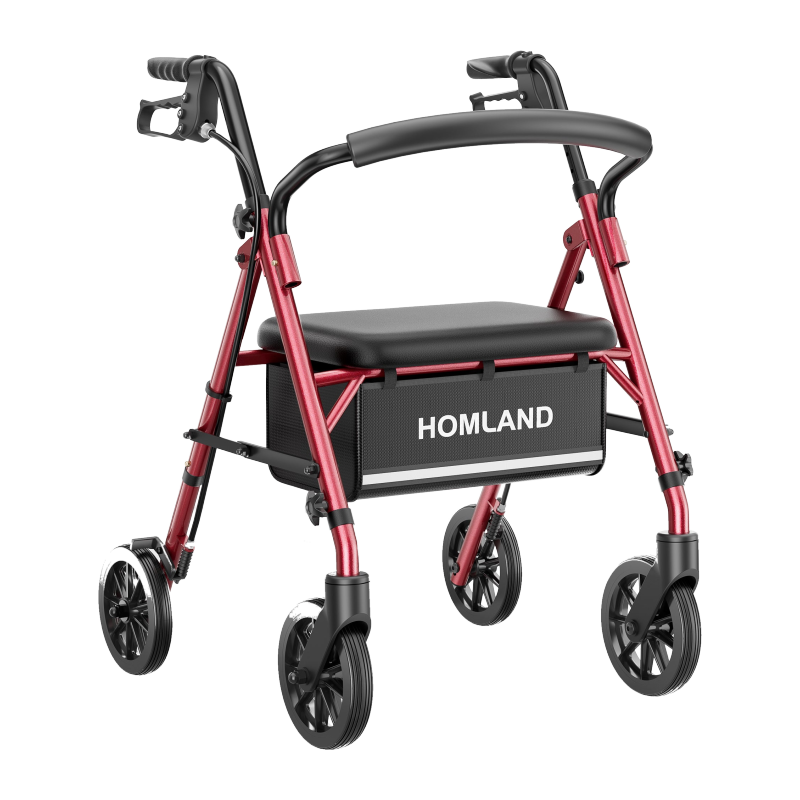
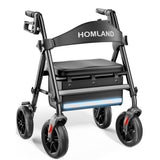
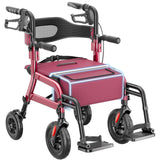
A rollator is a wheeled walker — most commonly with four wheels, though three-wheel versions exist for tighter spaces. Instead of lifting the frame, you push it forward as you walk. Rollators come equipped with hand brakes (so you control the pace), a built-in seat for resting whenever you need a break, and usually an under-seat pouch or basket for carrying everyday items like a phone, keys, or a water bottle.
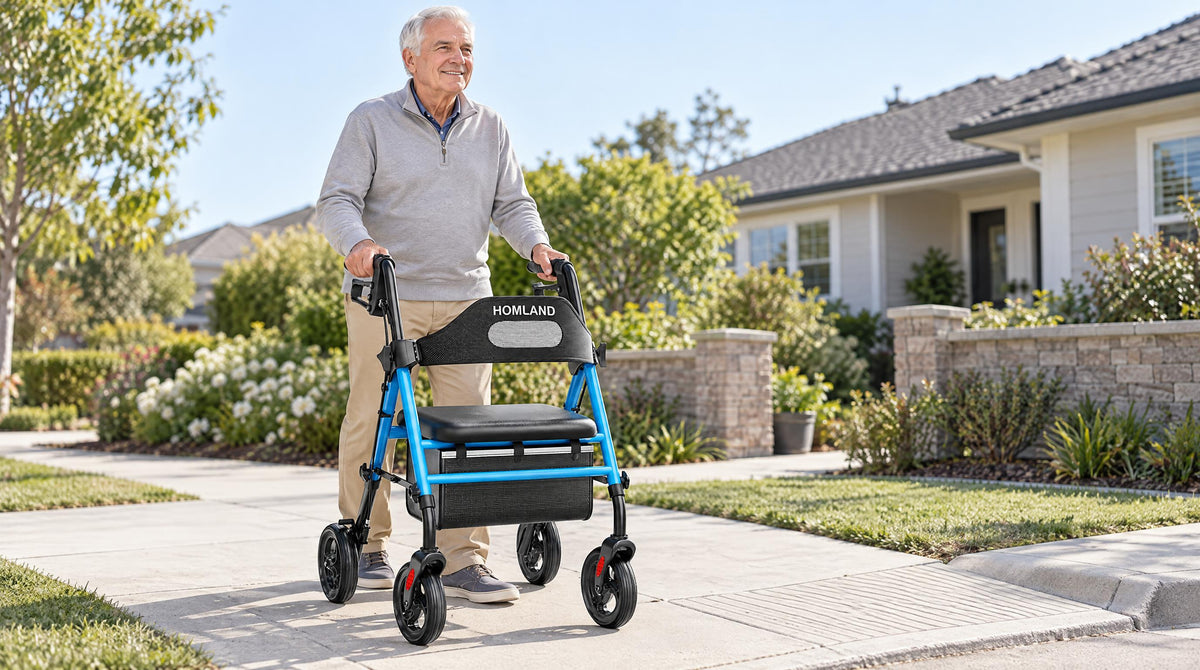
The rolling motion means a rollator supports a more natural, upright walking stride. For people who can walk reasonably well but fatigue quickly, or who need the option to sit down mid-route — at the grocery store, in a park, or just getting from the bedroom to the kitchen — a rollator offers a level of freedom that a standard walker simply can't match. It's less about maximum stability and more about sustainable, everyday mobility.
Explore HOMLAND's full range of rolling walkers, including 3-wheel, 4-wheel, upright, and bariatric models built to support up to 500 lbs with confidence.
Key Differences at a Glance
Before diving deeper into use cases, here's a clear side-by-side comparison of the two types:
| Feature | Standard Walker | Rollator |
|---|---|---|
| Movement style | Lift and place | Push and roll |
| Stability level | Maximum (static base) | High (with brakes engaged) |
| Walking pace | Slow, controlled | More natural gait |
| Built-in seat | No | Yes |
| Storage / basket | Usually not included | Yes (under-seat pouch) |
| Best for | Post-surgery, severe balance issues | Longer distances, active daily life |
| Upper body demand | Higher (repeated lifting) | Lower (pushing motion) |
When a Standard Walker Is the Better Choice
A standard walker is the right tool when stability cannot be compromised. If you've recently had a hip or knee replacement, are managing significant muscle weakness, or experience frequent balance disruptions, the lift-and-place design keeps you fully grounded with every step. There's no risk of the device rolling out from under you — a legitimate concern in the early weeks of recovery when confidence is still being rebuilt.
Standard walkers also tend to shine in tighter indoor spaces. Navigating a narrow hallway, moving around a small bathroom, or maneuvering between furniture is often easier with a compact, non-wheeled frame. If most of your daily movement happens within the home and involves short distances with rest stops built in, a standard walker may be all you need.
Consider a standard walker if any of these situations apply:
- You are in the early stages of recovery from surgery or injury
- A physical therapist has advised partial weight-bearing or maximum support
- You have significant upper-body strength and can manage the lifting motion comfortably
- Your primary environment is indoors on smooth, flat floors
- You prefer the predictability of a completely stationary support when you stop
When a Rollator Is the Better Choice
A rollator becomes the better option when life demands more than short trips across the living room. Picture this: you want to walk through a farmers' market on a Saturday morning, browse the grocery store aisles, or simply get to the mailbox and back without arriving exhausted. A rollator moves with you rather than requiring you to move it, which translates to far less fatigue over longer distances.
The built-in seat is often the deciding factor for people who tire easily or have conditions like heart disease, chronic obstructive pulmonary disease (COPD), or arthritis that demand frequent rest breaks. Being able to sit down anywhere — not just when a bench happens to be nearby — changes what's possible in a day. Physical therapists often recommend rollators for people who are mobile enough to push the device but need endurance support and an upright posture that reduces strain on the back.
A rollator is likely your best match if:
- You're reasonably mobile but fatigue quickly on longer walks
- You spend time outdoors, in stores, or in larger indoor spaces
- You want to carry items hands-free using the under-seat basket
- Maintaining an upright posture while walking is a priority
- You value the independence of being able to rest anywhere, anytime
Think About Where You'll Use It
Environment plays a bigger role in this decision than most people expect. Standard walkers perform best on flat, smooth indoor surfaces — hardwood, tile, or low-pile carpet. Rolling one across a gravel path or bumpy sidewalk isn't practical, and the lift-and-place mechanism was simply never designed for outdoor terrain.
Rollators, by contrast, handle both indoor and outdoor surfaces reasonably well, especially models with larger wheels. A 6-inch or 8-inch wheel rolls over minor cracks, small thresholds, and light outdoor terrain far more smoothly than smaller wheels. If the person using the device wants the freedom to move between the house and the yard, the driveway, or a walking path in the neighborhood, a rollator is almost always the more practical choice.
If outdoor use is a major factor, also consider a 3-wheel rollator for nimble turns in tighter spaces, or a heavy-duty 4-wheel model if extra capacity and durability are needed. HOMLAND's rolling walker collection covers all these variations in a single lineup.
Weight, Portability, and Storage
Practicalities matter when a mobility aid needs to travel with you. Standard walkers are generally lighter than rollators — they lack the wheel assemblies, braking hardware, and seat frame that add weight to a rollator. Most standard walkers fold flat for easy storage in a car trunk or a bedroom corner, making them convenient for people who travel or frequently visit family.
Rollators are slightly heavier but still fold compactly. Most modern designs fold down to a manageable size that fits in the back seat or trunk of a standard car. The trade-off in weight is offset by the added features, but if someone has limited upper-body strength or will need to load and unload the device frequently, it's worth comparing specific model weights before buying. For family caregivers helping an older parent, this is one of the most practical details to check.
What Physical Therapists Often Recommend
Physical therapists (DPTs) typically evaluate the person, not just the diagnosis. Two people recovering from the same surgery can have very different needs depending on their strength, balance, and home environment. That said, some general patterns consistently emerge from clinical guidance.
For acute recovery — the first few weeks after surgery or injury — physical therapists tend to favor standard walkers because maximum stability reduces fall risk during the most vulnerable period. As strength and confidence return, many therapists transition their patients to a rollator, which encourages a more natural gait pattern and reduces the forward-lean posture that standard walkers can inadvertently promote over time. Upright rollators are especially valued by therapists for this reason, since they position the handles higher and keep the spine properly aligned.
If you're unsure which device is right for your specific situation, a single session with a physical therapist can provide personalized guidance — and it's worth asking. HOMLAND products are authorized by licensed Doctors of Physical Therapy, which means the design decisions behind each product reflect that same clinical thinking applied to home use.
HOMLAND's Rollator and Walker Lineup
Whether you've decided on a rollator or a standard walker, HOMLAND builds both with the same commitment to safety, comfort, and dignity at home. Every product assembles without tools, adjusts to fit a wide range of heights, and arrives quickly from a US local warehouse. And because HOMLAND holds the #1 position on Amazon US in Rolling Walkers, you're choosing from a lineup that has already earned the trust of thousands of users across the country.
Here's a quick guide to the main categories:
- 4-Wheel Rollators: The most popular choice for everyday independence — stable, smooth-rolling, with a built-in seat and storage basket. Browse rolling walkers.
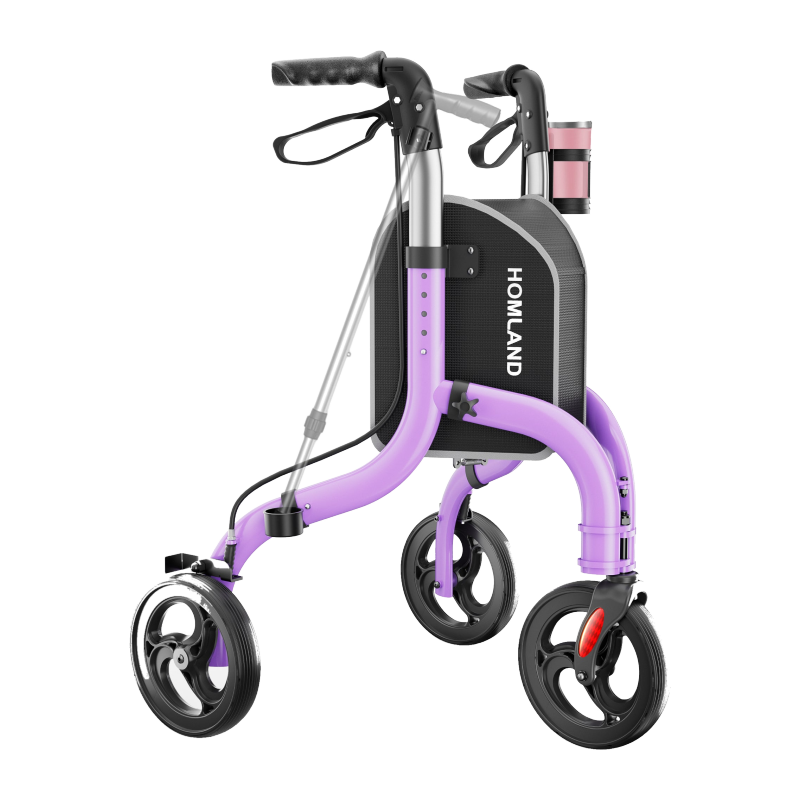
- 3-Wheel Rollators: Lighter and more maneuverable for tighter spaces, without a seat. Great for active users who prioritize agility.
- Upright Rollators: Higher handle position for people who experience back or shoulder discomfort with standard rollator heights.
- Bariatric Rollators: Heavy-duty frames built to support up to 500 lbs, without sacrificing ease of use or design.
- Standard Walkers: No-frills, maximum-stability frames for acute recovery and indoor use. Browse standard walkers.
All HOMLAND mobility aids are FSA/HSA eligible, covered by a 1-year manufacturer warranty plus a 1-year extended warranty, and supported by a US local warehouse for fast shipping. Browse the full HOMLAND product collection to find the right fit.
Making Your Final Decision
When you strip away the specs, the rollator vs. walker decision comes down to one core question: what does this person need most right now? If the answer is maximum, uncompromising stability during a vulnerable recovery period, a standard walker is the right call. If the answer is sustainable independence across a fuller range of daily activities — walking farther, resting when needed, carrying things without a bag — a rollator is almost certainly the better fit.
For families helping a parent or loved one make this choice, the most helpful thing you can do is watch how they actually move at home. Notice whether they tire on longer walks, whether they lean heavily on a surface for support, and whether they're currently active or mostly recovering. Those observations will tell you more than any checklist. And if you're still unsure, reach out to a physical therapist or contact the HOMLAND team directly — getting this right is worth the extra step.
Both rollators and standard walkers are genuinely valuable tools — they just serve different stages and styles of life. A standard walker offers the solid, steady foundation that early recovery demands. A rollator offers the rolling freedom that sustains everyday independence over the long haul. Neither is inherently better; the right one is simply the one that matches where you are right now and where you want to go.
Whatever you choose, you deserve a device that feels like part of your home, not a reminder of a hospital stay. That's the standard every HOMLAND product is built to meet.
Still Not Sure Which One Is Right for You?
The HOMLAND team is here to help you find the perfect fit — no pressure, no guesswork. Whether you have a question about a specific model, need help comparing options, or want guidance based on your situation, we're just a message away.